
Aging Well Abroad: Why Co-living Makes More Sense Than You Think
There is a growing body of research on what actually predicts healthy aging. It is not primarily about access to medical care, though that matters. It is about connection. People who have strong social ties, a sense of purpose, and daily human contact live longer, stay sharper, and report significantly higher quality of life than those who are isolated. This holds true regardless of physical health status.
Most of us know this intuitively. And yet the dominant model for aging in the United States pushes in exactly the opposite direction. You retire, perhaps downsize, and find yourself spending increasing amounts of time alone. Your social network shrinks as people move, become ill, or die. The structure that work once provided disappears. The cultural message is that this is simply what getting older looks like.
It does not have to look like that.
What Co-living Actually Offers
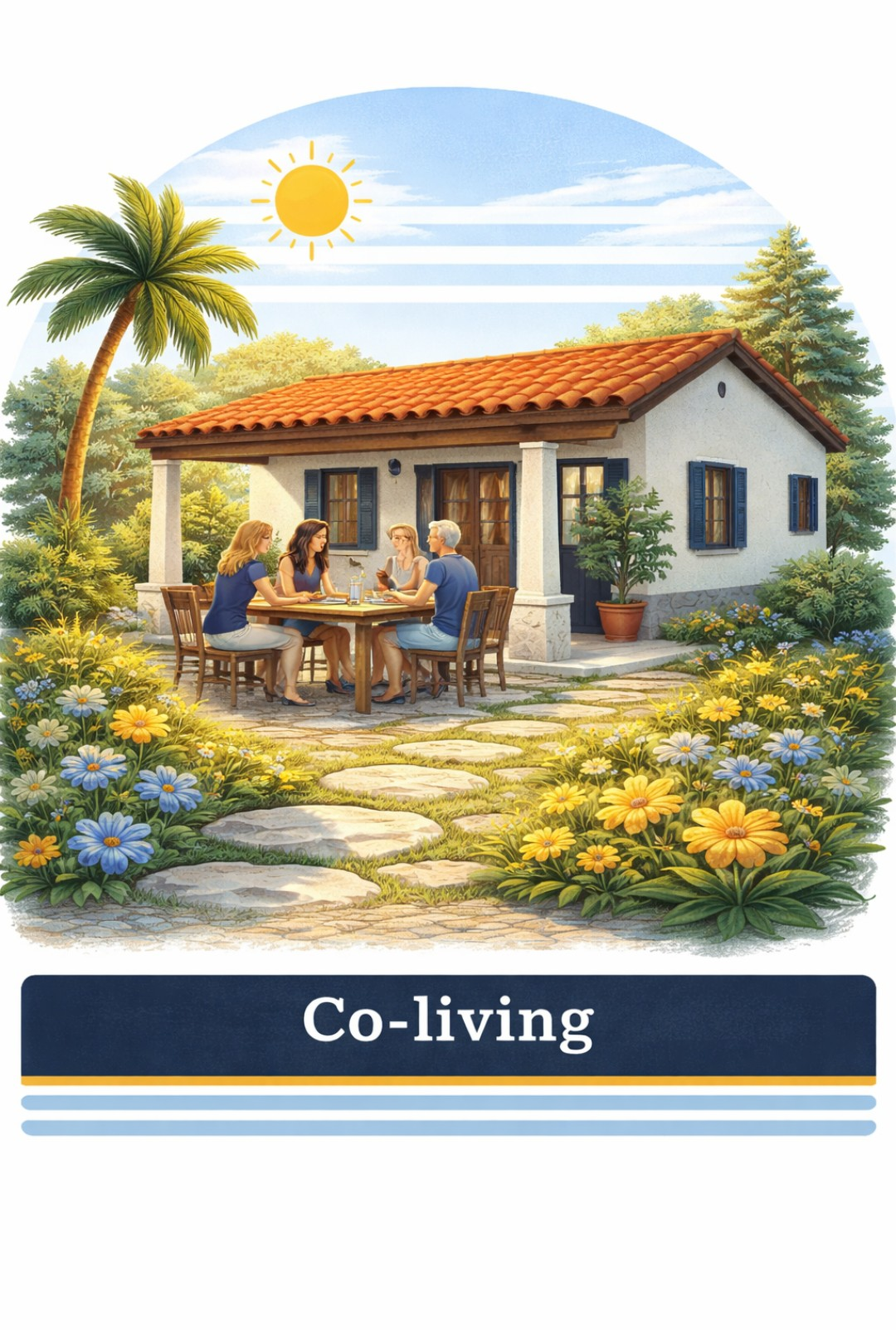
Co-living means sharing a home with a small number of other adults by deliberate choice. It addresses the isolation problem directly, by making connection available rather than forcing it. When you live with other people, things happen naturally. Someone makes an extra cup of coffee and calls out to ask if you want one. Someone notices you seem tired and checks in. Someone is going to the market anyway and asks if you need anything. These are small things individually. Collectively they are the texture of a life that feels inhabited rather than endured.
For women in their 50s, 60s, 70s and beyond who are navigating major life transitions, co-living offers something that solo living simply cannot. You have your own private space. You also have people around you. You are part of something without having to give up your independence to be part of it.
Why Abroad
When you arrive somewhere new, especially somewhere where you do not yet speak the language fluently, the pull toward isolation is strong. Everything is unfamiliar. Simple tasks take more effort. The social networks you spent decades building are thousands of miles away.
Co-living abroad changes that dynamic significantly. Your housemates are navigating the same transition. They understand the disorientation because they are living it alongside you. The shared experience tends to create bonds quickly, often more quickly and more genuinely than friendships formed over years at home, because the context is real and the stakes feel higher.
There is also something liberating about starting over somewhere new. The identity you carried for decades, defined by your career, your role in a family, your position in a community, does not automatically follow you across an ocean. You get to decide, perhaps for the first time in a long time, how you want to spend your days and who you want to spend them with. Co-living gives you the support structure to figure that out without having to figure it out alone.
Why Piriápolis
Piriápolis is a small, walkable beach town on Uruguay’s Atlantic coast, about 90 minutes from Montevideo and 30 minutes from Punta del Este. It is affordable, safe, and genuinely welcoming to expats. The healthcare infrastructure is stronger than the town’s size suggests, with access to English-speaking specialists and comprehensive private health coverage generally available for under USD $200 per month. The pace of life here is unhurried in a way that supports the kind of intentional daily living that healthy aging requires.
It is also simply a good place to be. The beach is a short walk. The hills behind town are good for a daily hike. The market, the restaurants, the promenade along the water, all of it is on a human scale that makes daily life feel manageable and pleasurable.
What We Are Building
Piriápolis Co-living is developing two co-living houses here. One is focused on independent communal living at approximately USD $650 per month, all-inclusive. The other offers a higher level of daily support for residents who want or need assistance with meals, transportation, healthcare coordination, and more, at approximately USD $1,300 per month. Both are designed around the belief that aging well is something you choose, and that the environment you choose to do it in matters enormously.
If you are thinking about what your next chapter looks like, we would love to talk. Reach out via WhatsApp at +598 98 291 591 or email bookings@piriapoliscoliving.com. And if you want to experience Piriápolis before committing to anything, The Piriápolis Experience is a good place to start.